SIN, COS & TAN Trigonometric Formulas
Learn forward and inverse trigonometry in Excel with SIN, COS, TAN, ASIN, ACOS, and ATAN. Learn radian conversion and solve geometric slopes accurately.

SIN, COS & Inverse Trigonometric Formulas
In structural engineering, loading dock design, and civil construction, engineers evaluate slope gradients and cable tensions using trigonometry. A ramp might have a vertical rise of 1.5 meters over a 10-meter horizontal run, giving a slope ratio of 0.15.
When you want to know the angle in degrees, you use the inverse tangent function: =ATAN(0.15). But Excel returns 0.14889. Without realizing that inverse functions output radians, you might think the angle is only 0.15 degrees, when the real slope is actually 8.53 degrees!
Learning the two-way workflow between degrees, radians, and trigonometric functions ensures your engineering and construction models are 100% dependable.
Standard Trig (SIN, COS, TAN)
Takes an angle in radians (wrap degrees in RADIANS()) and returns the ratio of triangle sides.
Inverse Trig (ASIN, ACOS, ATAN)
Takes a side ratio and returns an angle in radians. Wrap the output in DEGREES() to read degrees.
Quick Comparison: Forward vs Inverse Trigonometry
| Calculation Direction | Formulas Used | Input Format | Output Format | Conversion Required? |
|---|---|---|---|---|
| Forward Trig (Find Side) | SIN, COS, TAN | Radian angle | Numeric ratio | Yes: Convert input from degrees via RADIANS() |
| Inverse Trig (Find Angle) | ASIN, ACOS, ATAN | Numeric ratio | Radian angle | Yes: Convert output to degrees via DEGREES() |
How the Trigonometric Engines Work
1. Forward Trigonometry Workflow
To find the vertical height of a cable with a length of 50 meters and an angle of 30 degrees:
=Length * SIN(RADIANS(AngleInDegrees))
=50 * SIN(RADIANS(30))    ' Returns 25.0 meters
2. Inverse Trigonometry Workflow
To calculate the angle from a slope ratio of 0.15:
=DEGREES(ATAN(SlopeRatio))
=DEGREES(ATAN(0.15))       ' Returns 8.53 degrees
3. Input Limits for ASIN and ACOS
In a right-angled triangle, neither side can exceed the hypotenuse. Consequently, ASIN and ACOS strictly accept values between -1 and +1. Supplying a number outside this range (like ASIN(1.2)) triggers a #NUM! error.
Real-Life Workplace Scenarios
1. Disability Ramp Compliance (ADA Guidelines)
Building safety codes require wheelchair ramps not to exceed a 4.76-degree slope (a 1:12 ratio or 0.0833). Inspectors verify compliance using:
=DEGREES(ATAN(Rise / Run)) <= 4.762. Solar Panel Tilt Angle Efficiency
Renewable energy installers calculate panel shadow lengths and winter sun elevation angles using cosine formulas.
Common Mistakes to Avoid
- Forgetting DEGREES on Inverses: Reading raw radians as degrees will result in answers that are roughly 57 times smaller than expected.
- Values Outside [-1, 1] in ASIN: Confirm your ratio is Opposite / Hypotenuse, not Hypotenuse / Opposite.
Analyze construction ramp angles in our spreadsheet playground below.
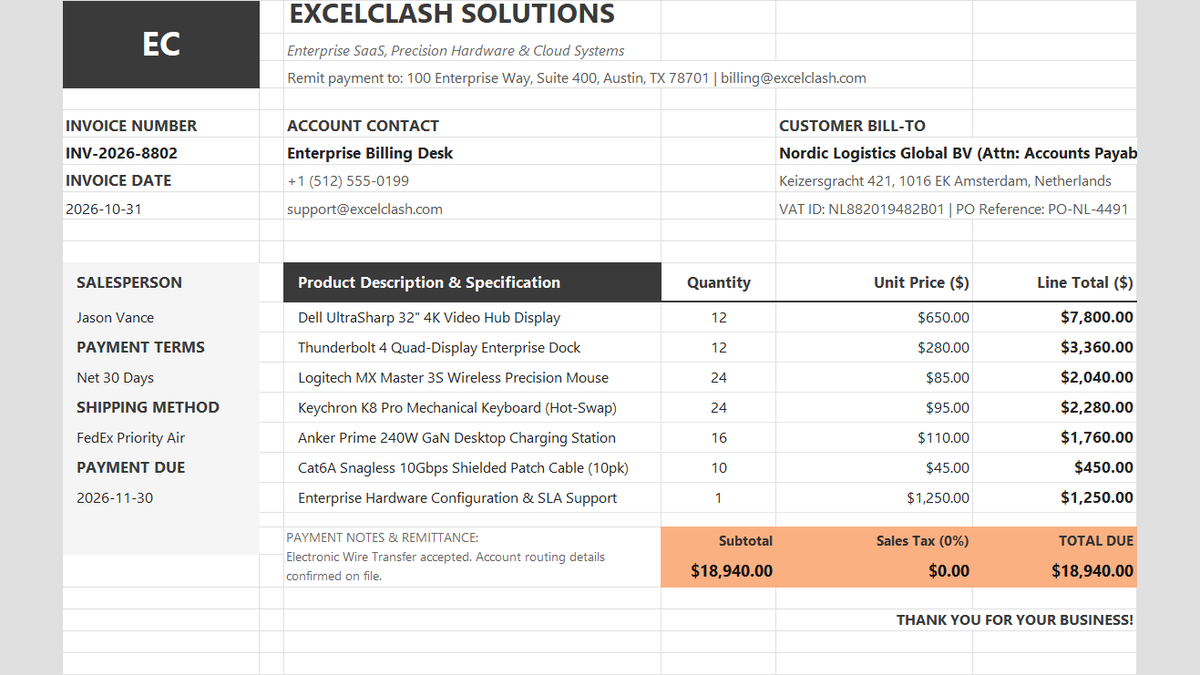
Ready to apply SIN, COS & TAN Trigonometric Formulas in a real workbook?
See how math formulas automate row totals, tiered discounts, and tax computations.
Open Automated Commercial Sales InvoiceShare This Lesson
Spread the word with your peers and challenge your friends